


More forward-thinking companies across sectors are choosing to outsource their customer service operations to trusted specialists.
Why? Outsourcing customer services comes with many benefits; you can focus on more strategic activities and improve your consumer-facing communications across every channel.
Doing so means you can remain responsive, boost satisfaction levels and improve the standard of customer experience you offer.
If you have been thinking about it but you are not sure where to start, this guide is for you. We will explain what customer service outsourcing actually is, the benefits it can bring, the trade-offs to weigh up and the practices that separate a good partnership from a frustrating one.
We will also walk through what to look for when you choose a partner.
What is customer service outsourcing?
Customer service outsourcing is when you hire an outside company to handle customer enquiries and support on your behalf, rather than employing and managing that team yourself.
It is one type of business process outsourcing, or BPO, which simply means paying a specialist provider to run a defined part of your operation, customer service in this case, so you do not have to.
As customers spread their questions across more and more channels, keeping a consistent standard of support gets harder. An outsourced team is built to handle that range, which usually includes:
- Inbound and outbound calls
- Email support
- Live chat
- Social media and messaging
Handing these over gives you access to a provider’s people, systems and experience, so you are not starting from scratch or stretching a small in-house team too thin.
It tends to be most useful for companies with call volumes that rise and fall through the year, or those without the in-house resource to cover everything themselves. The main draws are flexibility, the ability to scale and the chance to reduce some of the cost of running support on your own.
In-house vs outsourced customer service: which is right for you?
Running customer service in-house is a perfectly good option for some businesses. It comes down to weighing up what you gain against what it costs you.
An in-house team gives you direct control and full ownership of how things are done. The trade-off is that you carry everything: the technology, the premises, the hiring, the training and the day-to-day management. That can get expensive and time-consuming, especially if your resources are already tight.
An outsourced team flips that. You get access to trained staff and people who handle support for a living, on infrastructure that already exists and you can usually dial capacity up or down as demand changes.
Neither is automatically better. Here is a side-by-side to make the comparison clearer.
| Consideration | In-house | Outsourced |
|---|---|---|
| Control | Direct control over your processes. | Less direct control; managed by a third party. |
| Expertise | You hire and train it yourself. | Access to trained staff and experienced specialists. |
| Cost | High investment in technology, premises and staff. | Often lower overheads, with cost spread across a provider. |
| Management | You handle hiring, training and daily management. | The provider manages staffing and operations. |
| Scalability | Slower and harder to scale up or down. | Easier to scale with demand. |
| Efficiency | Depends on your internal resources. | Established systems and experience can lift efficiency. |
| Focus | Pulls time and attention away from other work. | Frees up your team for other priorities. |
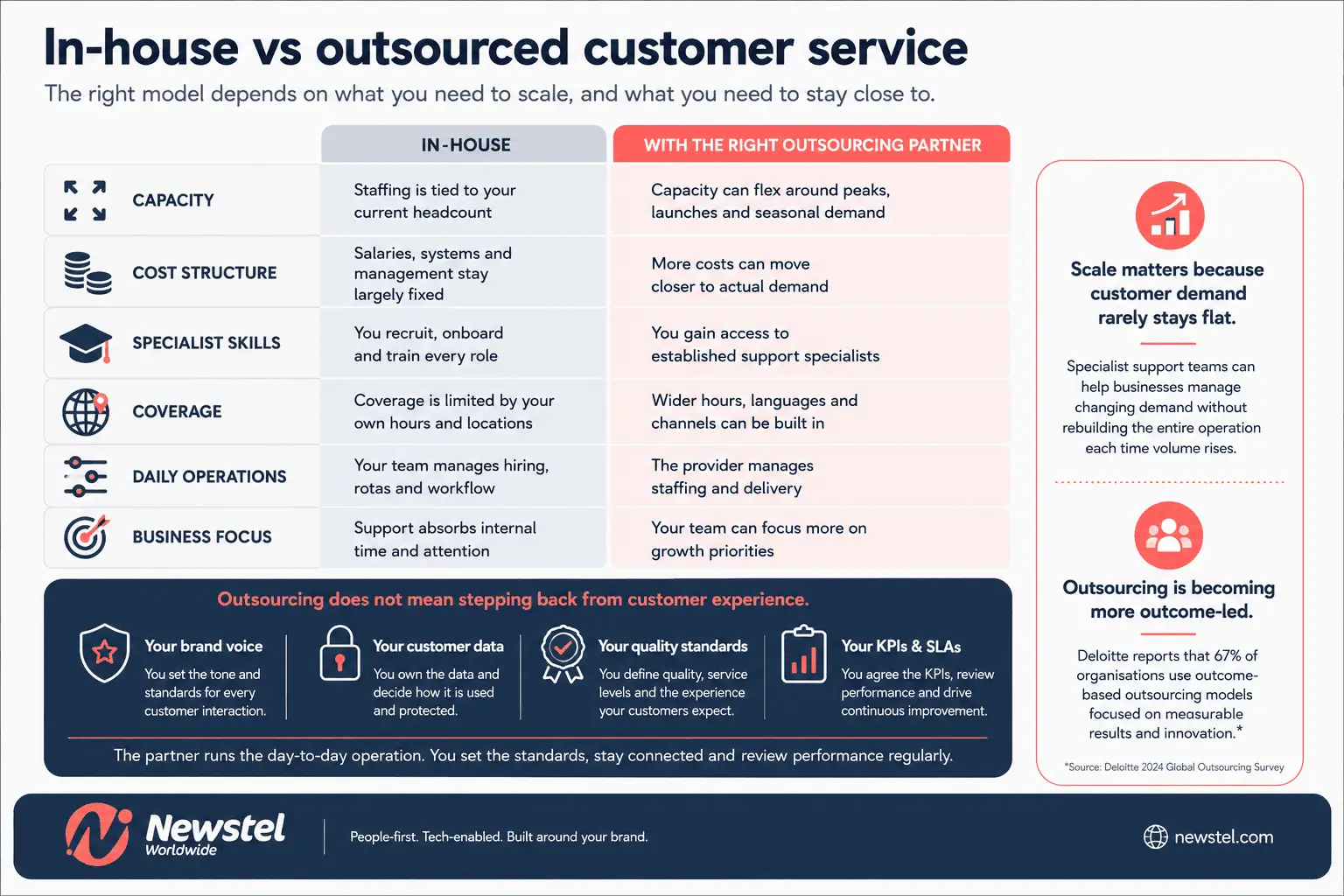
The pros and cons of outsourcing customer service
Like any business decision, outsourcing has real advantages and some genuine drawbacks. It is worth being clear-eyed about both before you commit.
The benefits of outsourcing customer service
Done with the right partner, outsourcing can lift customer satisfaction, tidy up your operations and give you room to grow. Here is how.
Scale your support up and down with demand
One of the biggest advantages is being able to match your support capacity to actual demand.
An in-house team is capped by how many people you employ. With an outsourced team, you can adjust capacity to cope with busy spells and seasonal spikes, so customers are not left waiting when volumes jump. That keeps service steadier through the peaks and troughs that catch a fixed team out.
Lower and more flexible costs
Cost is often the deciding factor and for good reason.
Running your own contact centre means paying for premises, technology, training and salaries, whether or not the phones are busy. Outsourcing turns a lot of that fixed cost into a variable one. Many providers work on a pay-per-use basis, so you are paying for the support you actually need rather than carrying a full team through quiet periods.
That frees up budget to put towards other parts of the business, which is usually where the bigger return sits.
Access to a wider talent pool and longer hours

Outsourcing can also give you access to people in different locations and the option of support outside your own working day.
By drawing on staff in more than one region, a provider can cover more hours and, in many cases, more languages. If you sell to customers in different time zones or countries, that reach is hard and expensive to build yourself. (If multilingual cover matters to you, that is worth raising early, since not every provider offers it; this is one area Newstel specialises in through its multilingual support teams.)
More time for the work only you can do
Perhaps the most underrated benefit: handing off support lets you put your own time back into the things that move the business, like product, marketing and sales, while customers still get looked after.
In practice, that lets you:
- Build trust and reputation by giving customers a reliably good experience
- Spend your time and resources more deliberately, on the work that grows the business
The challenges of outsourcing customer service
Now the other side. These are the issues that come up most often and they are all manageable if you plan for them.
Cultural and language differences
If your provider’s team sits in a different country, cultural and language differences can be a hurdle, though a good provider turns this into a strength rather than a weakness.
The fix is partly about people and partly about process: multilingual staff, training on cultural awareness and clear communication tools so nothing gets lost in translation. Handled properly, a broader team can actually improve the service your customers get.
Data security and data protection
When an outside team handles your customers’ data, you need to be confident it is protected.
That means encryption (scrambling data so only authorised people can read it), access controls (limiting who can see what) and regular audits. For UK and European businesses, the key standard is GDPR, the data protection law covering the UK and EU. (HIPAA, which the original US guidance often mentions, is a US healthcare-specific rule, so it only applies if you handle American health data.)
The point is simple: choose a provider that takes security seriously and can show you how they handle it.
Managing performance and service levels
With less hands-on control, you need a clear way to keep standards up. That comes down to agreeing the right measures up front.
A few worth knowing:
- KPIs (key performance indicators): the handful of numbers you agree to judge success by.
- Average handle time: how long a typical contact takes to deal with from start to finish.
- First call resolution: the share of issues sorted on the first contact, so the customer does not have to chase.
Pair those with regular reviews and ongoing training and you can hold an outsourced team to the same standard you would expect in-house.
Three best practices for outsourcing customer service well
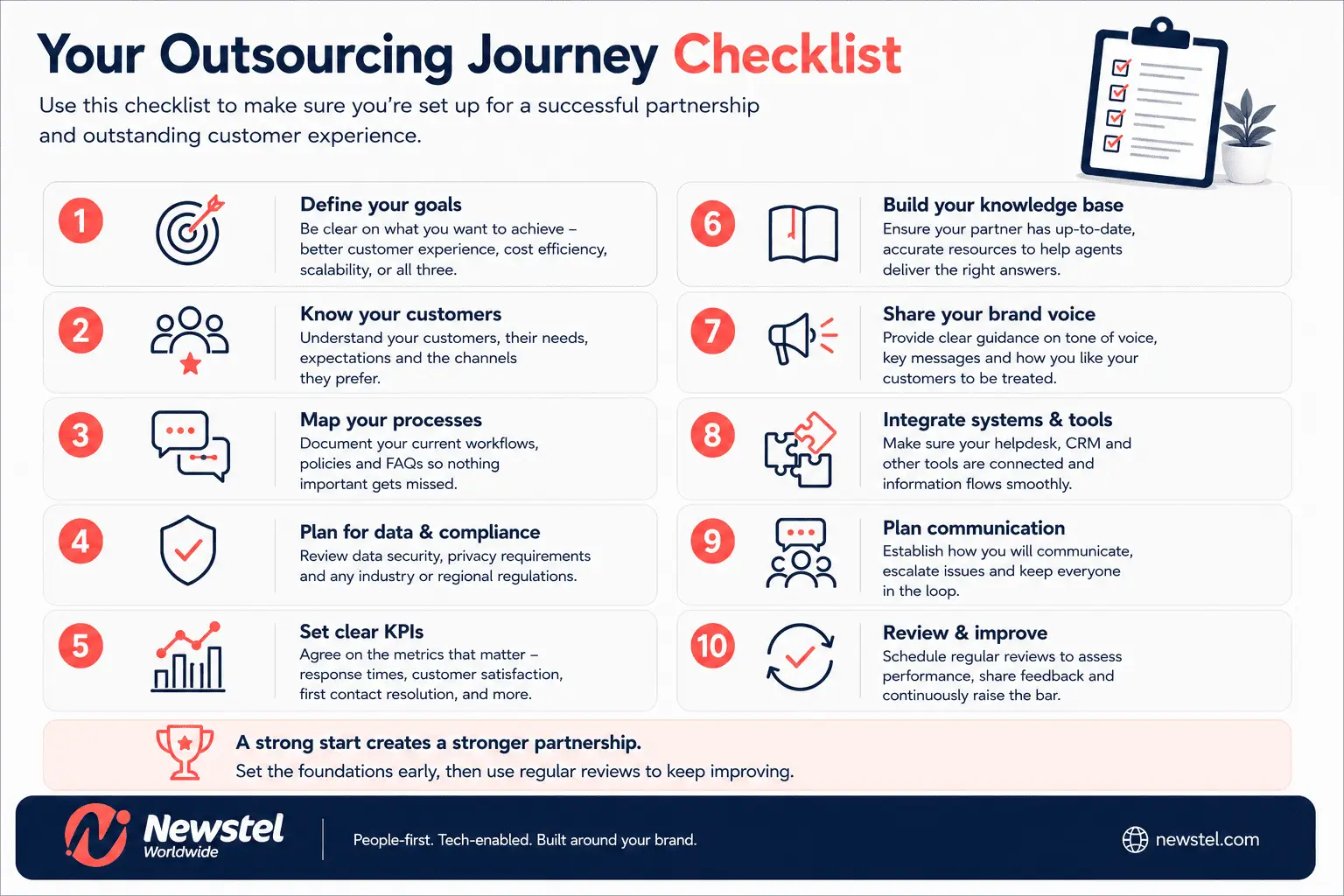
The difference between a smooth partnership and a painful one usually comes down to a few habits. Start with these.
1. Set up clear communication channels
Decide early how you and your provider will stay in touch and share information.
Shared tools, like a connected CRM (the system that stores your customer records and history) and a common chat channel, keep everyone working from the same picture. Regular check-ins catch small problems before they grow.
The takeaway: clear, open communication is the foundation everything else sits on.
2. Agree realistic expectations and KPIs
Set out what good looks like before you go live, not after.
Define your performance goals and the numbers you will track and base them on your own history and sensible industry benchmarks rather than wishful thinking. Then review them regularly and adjust as you learn. This keeps both sides accountable and gives you a steady basis for improvement.
3. Build in continuous training and quality checks

Standards slip without upkeep, so treat training and quality assurance as ongoing rather than one-off.
Regular training keeps the team sharp across phone, chat and social. Quality checks, where someone reviews a sample of real interactions against agreed standards, let you spot issues and fix them. Together they create a habit of steady improvement rather than firefighting.
How to choose the right outsourcing partner
So what should you actually look for? Here is how to separate a good fit from a risky one.
Look at the right things
A few criteria are worth weighting heavily:
- A track record in customer service across the channels you care about, whether that is phone, chat or social.
- Evidence they can keep customers satisfied, not just claims.
- Experience handling both inbound and outbound work, including any specialist needs like technical support.
- A genuine fit with how you operate and where you are trying to grow.
Ask the right questions
When you talk to a potential partner, put a few direct questions to them:
- How do you keep customer satisfaction high?
- How do you cope with sudden spikes in volume without service dropping?
- Can you give examples of work you have done for businesses like ours?
- How do you keep our data secure and compliant?
- How will you fit in with the systems and tools we already use?
Note the answers down. Side by side, it usually becomes clear quite quickly which provider is the better fit.
Check the technology fits
To avoid problems later, compare your technical setup with what a provider can actually support.
Make sure your key systems line up, for example your CRM, your helpdesk and your IVR (the automated phone menus that ask callers to “press 1 for sales”). Check how they protect data and whether their setup can grow as you do. A short audit of their infrastructure before you sign is time well spent.
FAQs
Start by getting clear on what you actually need, what success looks like and what matters most in a provider. From there, research the options and draw up a short brief, sometimes called an RFP (request for proposal), that sets out your requirements so providers can pitch against them. Review the responses, shortlist a few and interview them with the questions above. That process gives you a solid basis for making a good choice.
Build the checks in from the start. Agree on clear KPIs, hold regular performance reviews, keep communication open and make sure the provider runs ongoing training. The combination is what keeps standards steady over time, rather than slipping once the novelty wears off.
A few worth watching:
– AI in support, used to handle routine queries and help human agents work faster
– Omnichannel support, meaning phone, email, chat and social handled in a joined-up way rather than as separate silos
– Remote and distributed teams, which widen the talent pool a provider can draw on
Most of these are aimed at the same thing: better service at a more sensible cost.
Taking control of your customer service strategy
The benefits of outsourcing are real: lower and more flexible costs, access to a wider team, longer hours of cover and more of your own time back for the work that grows the business.
The catch is that all of it depends on choosing the right partner. Take the time to research properly, ask direct questions and check the fit before you commit.
If you would like to talk it through, we are happy to help. Newstel handles customer service outsourcing for businesses across the UK and Europe, including high volumes and support in multiple languages. Get in touch and we will give you a straight answer on whether it is a good fit for you.