


If you’re looking to expand your business globally, providing professional multilingual support is non-negotiable.
While many ambitious businesses across sectors want to connect with international audiences, many fail to provide the level of customer support that drives loyalty or growth.
Offering exceptional multilingual customer support is vital to building lasting connections and creating personalised customer experiences worldwide.
But what is multilingual customer support, why is it important, and how can it help you expand into new global markets?
Discover all you need to know right here in this definitive guide.
What is multilingual customer support?
Multilingual customer support is about delivering a consistently exceptional level of service across multiple languages to reach new international audiences.
It’s a strategy and a solution that’s ideal for businesses that want to expand globally and diversify their customer base.
From call centre support and live chat to email, social media, and beyond, multilingual customer assistance covers all communication bases in a way that really speaks to your audience.
If you’re only offering customer support in English, you’re likely missing out on countless customers worldwide.
On the flip side, prioritising your multilingual support strategy could make your business more inclusive and more profitable.
Why is multilingual customer support important?
Scaling globally isn’t just about pushing into new markets, it’s about building trust and meaningful connections.
If your messaging or communications get lost in translation, you’ll stunt your international growth and potentially miss out on customers.
But investing in streamlined multilingual support operations will help you connect with customers in several different languages, grow your customer base, and improve your retention rates. It’s a win-win-win.
Working with a multilingual support partner can also help you prevent costly compliance issues. For instance, if your legal and financial documents aren’t properly translated, you could lose time and money.
Yes, bad translations cost businesses millions every year, but they don’t have to cost you. Here’s what you need to succeed:
- Flawless translations: No translation tool mistakes, disasters, or messaging mishaps.
- Native-level customer service: No clunky, robotic responses that confuse or frustrate potential customers.
- Cultural accuracy: Words alone aren’t enough. Your messages should feel natural and authentic.
- Consistent branding: One message in multiple languages, delivered with care, clarity, and precision.
Your competitors are already offering customer support in several languages (if not, they’re likely considering it). If you’re not, you’re losing ground.
What are the benefits of multilingual customer service?
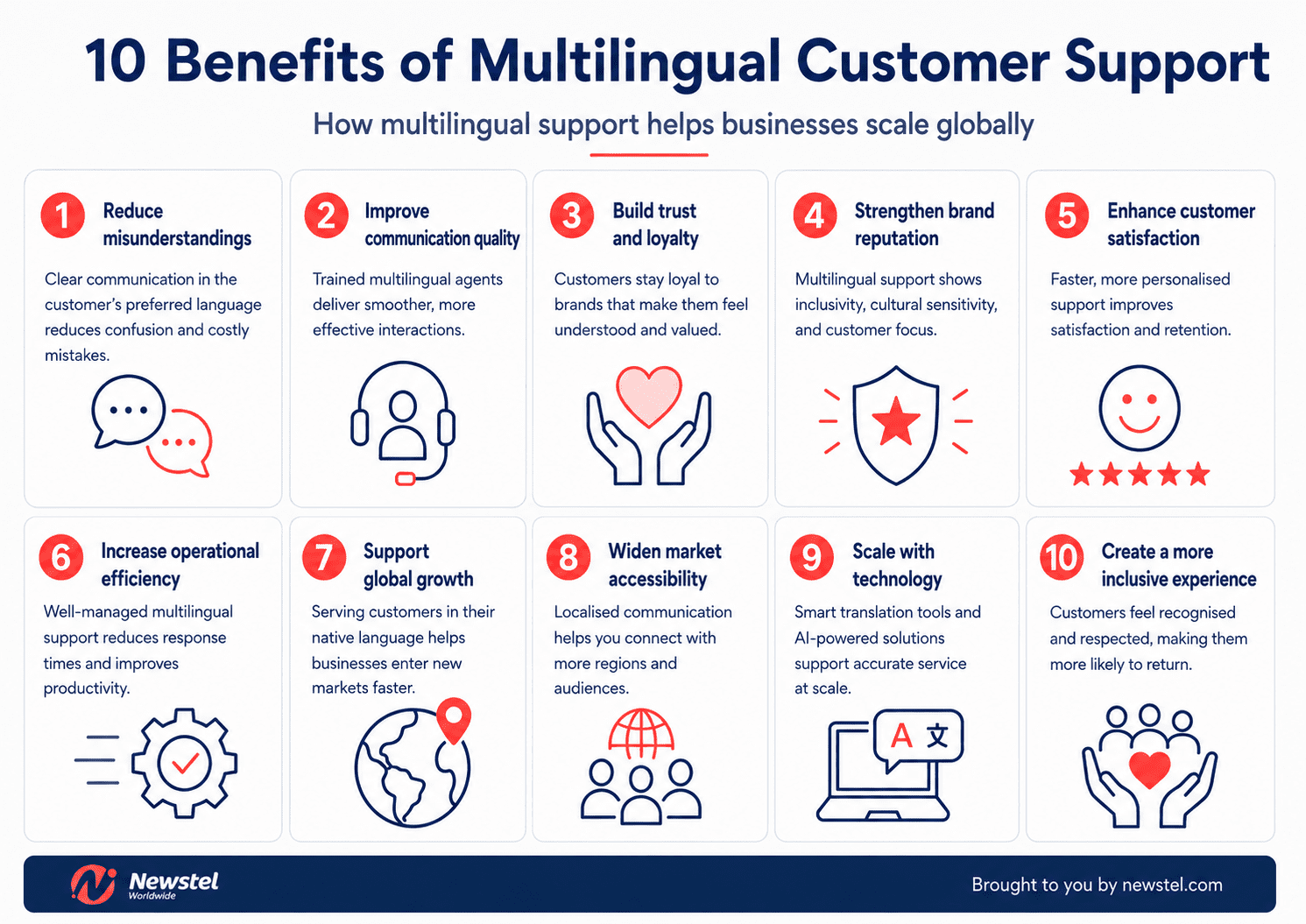
There are several benefits to offering multilingual customer support as a business. Connecting with customers in their native tongue across their preferred channels can:
- Reduce misunderstandings: Multilingual support helps customers communicate clearly in their preferred or native language. Being able to do so can reduce confusion, frustration, and misunderstandings.
- Improve communication quality: Combining trained multilingual agents with cultural awareness and customer service know-how leads to smoother, more effective customer interactions that build connections and drive conversions.
- Build trust and loyalty: Customers are far more likely to stay loyal to brands that make them feel understood and valued. Serving people in their language will get your relationship off to the best possible start.
- Strengthen your brand reputation: Offering support in multiple languages demonstrates a clear commitment to inclusivity, cultural sensitivity, and providing an exceptional customer experience (CX).
- Enhance customer satisfaction: Faster resolutions and more personalised support typically lead to better consumer experiences and better customer retention rates.
- Increase operational efficiency: Done right, multilingual support can streamline your communications, reduce response times, and improve productivity across your customer service teams.
- Support and expand global growth: You can reach wider audiences while entering new markets faster and more consistently by communicating with customers in their native language.
- Widen market accessibility: Localised communication can help your business connect with diverse regions and demographics, especially in lucrative international markets such as Europe, the Middle East, and Africa (EMEA).
- Use technology for added scalability: Smart translation tools and AI-powered solutions can enable faster, more accurate support at scale while complementing your human agents’ efforts.
- Create a more inclusive customer experience: Offering professional multilingual assistance makes customers from different cultural and linguistic backgrounds feel recognised and respected. The outcome? They’ll stay loyal to your business and become committed brand advocates (which means more customers!)
If you’re a scaling business serious about growing globally, working with a trusted multilingual customer support partner is certainly worth considering.
Should you outsource multilingual support?
Working with the right outsourcing partner means you can consistently deliver an exceptional customer experience across several languages. You’ll also be able to provide 24/7 coverage, handle fluctuating enquiry volumes, and reduce your operational overheads.
How to scale customer support internationally: what you need to know

Now you’re up to speed with the concept and benefits of multilingual customer support services, let’s consider how to successfully scale internationally.
1. Hire professional translators (not AI alone)
AI is a powerful companion for human customer service specialists. But it’s not perfect, especially when it comes to business-critical communications.
Professional human translators ensure:
- Context isn’t lost in communications and translations
- Idioms or local terms don’t turn into nonsense
- Your tone stays consistent
Yes, machine translation tools like DeepL or ChatGPT can help with speed. But you should always have a human specialist double-check customer-facing communications before you send or publish them.
Remember: One mistranslation or mistake could damage your credibility and cost you your business.
2. Invest in reliable multilingual business support for customer service
Your customers need help in their language. As we mentioned earlier, doing so reliably can significantly benefit your business growth.
So, how can you make it happen? Let’s take a look:
- Hire an in-house multilingual team: Expensive, but gives you full control.
- Use AI-powered chatbots: Great for FAQs but not for deep customer issues.
- Try outsourced multilingual support: Cost-effective, consistent, and scalable.
Tip: If you choose to outsource your multilingual support, choose a provider with native speakers who understand cultural nuances.
For instance, a customer asking a simple refund question in Spanish shouldn’t get an automated response that makes little sense.
Investing in cost-effective multilingual support solutions ensures customers receive accurate, timely, and culturally appropriate responses.
3. Translate and localise your content (Not just copy-paste)
Reliable multilingual business support requires translation and localisation that offers genuine value to your customers.
That means localising your content to match:
- Cultural norms and expectations
- Local slang, phrasing, and expressions
- Date, time, and currency formats
- Search engine preferences (yes, SEO changes by language)
For instance, what works in the UK might translate poorly in Japan. So, take the time to tailor your content accordingly, including:
- Marketing campaigns
- Ad creatives and product descriptions
- Customer service resources like guides, manuals, and FAQs
- Email and communication templates
4. Optimise your website for reliable multilingual business support
There’s no getting around it: your website is your digital storefront. Make it multilingual-friendly, and you’ll start connecting with new international audiences.
Here’s what to consider:
- Use hreflang tags for SEO
- Offer language switchers (don’t auto-redirect based on IP, people don’t like it)
- Ensure your checkout process supports multiple languages & currencies
- Translate everything, including meta descriptions, alt text, and error messages
Remember: Your site should feel natural for every customer, no matter where they are in the world.
5. Nail multilingual email & social media marketing
Customers don’t just visit your site. They also engage with your online chat services, emails, campaigns, messaging, and social media communications.
If you’re serious about international markets, your marketing needs to be multilingual too.
Dos & don’ts:
- Do segment email lists by language & region
- Do create platform-specific content
- Do hire local influencers to boost credibility
- Do localise your social media ads. One-size-fits-all won’t work
- Don’t assume Google Translate is enough
- Don’t post in English and expect engagement worldwide
6. Stay compliant with international business regulations
Reliable multilingual business support isn’t just about language. To scale smartly and remain compliant, you also need to consider international rules and regulations.
Different countries have different laws around:
- Privacy & data protection: GDPR, anyone?
- Consumer rights: Refund policies change by region
- Tax & invoicing rules: VAT and GST, among others
Making mistakes in these areas isn’t just costly. In extreme cases, compliance issues could shut down your operations.
Hiring local legal experts or a trusted multilingual customer support partner will help you navigate these nuances and avoid making any stressful mistakes in new markets.
The best tools for reliable multilingual business support
You don’t need to do everything manually. The best multilingual support providers train their international agents to use the right tools to streamline their workflows and enhance the overall customer experience.
For your reference, here are some top tools to streamline multilingual operations:
- Zendesk & Freshdesk: Multilingual customer support platforms.
- DeepL & Smartling: Advanced translation tools.
- Crowdin & Lokalise: Content localisation platforms.
- HubSpot & Mailchimp: Multilingual email marketing.
- Google’s Hreflang Tag Generator: Helps with SEO for different languages.
Tip: When considering working with a trusted outsourcing partner, ask them which tools they use to improve the multilingual support they can offer your customers.
FAQs on global customer support services
Multilingual customer support solutions are strategies and tools that businesses use to provide quality customer service in multiple languages.
These solutions include using multilingual staff, translation services, and technology to communicate with customers in their preferred language and expand globally.
If you’re considering how to consistently and cost-effectively support international customers, outsourcing is an attractive option.
When building an in-house multilingual support team, there are significant upfront and ongoing overheads to consider. These usually include equipment, office space, remote working infrastructure, ongoing training, and employment costs.
The best multilingual support partners are already equipped with everything you need to offer exceptional support in your target languages. That means that overall, outsourcing is often more affordable than handling international support in-house. The best partners will also scale their support up and down depending on your business needs.
The best languages for multilingual support will vary depending on the specific regions and markets you want to target.
But the customer support languages in the highest demand right now include Hindi, Spanish, French, Portuguese, Mandarin, and Arabic.
Used effectively and with care, language translation tools provide a quick and flexible way of creating communications in other languages. However, there’s no substitute for human multilingual support specialists who can connect with your target customers in a meaningful way that drives conversions and repeat business.
The best multilingual support teams use smart automation and translation tools to complement their efforts. But these teams have the experience, knowledge, and linguistic skills to deliver customer experiences that drive consistent growth.
Scale globally with a multilingual customer support partner

Now that you know how offering multilingual customer support can help you scale globally, it’s time to take action.
If you want to reach new international audiences, working with the right multilingual support partner is the best way to get there.
It’s how ecommerce teams handle international support. It’s how B2B SaaS teams offer multilingual support. It’s how businesses across every other sector imaginable are expanding their global reach through customer service.
As a leading multilingual customer support outsourcing specialist, we can partner with you to scale globally.
Our team of international customer service specialists can cross-channel communications in your target markets with ease. This makes us the ideal choice for your multilingual service outsourcing needs.